
New Non-Platinum Fuel Cell Catalyst
- Technology Application
- Use of metal or metal oxide doped graphitic nanofibers as a durable catalyst in fuel cell anodesUse of resulting catalyst in fuel cells for generation, transport or storage of electricity for other uses.
- Detailed Technology Description
- None
- Others
-
Background
Fuel cells are currently used to power cars as a green alternative to gasoline powered engines. They offer advantages over conventional combustion technologies, including higher efficiency, quieter operation and lower emissions. Hydrogen fuel cells emit only water rather than green house gases. A critical barrier to faster fuel cell adoption is the cost of platinum since it is used as a catalyst on the electrodes of the fuel cell. This high cost of platinum drives the need for inexpensive alternative catalyst materials.
Related Materials
Tech ID/UC Case
29352/2017-156-0
Related Cases
2017-156-0
- *Abstract
-
The Kisailus research group at the University of California, Riverside, has developed a novel fuel cell catalyst made of porous carbon nanofibers doped with inexpensive metal or metal oxide nanoparticles that provide active sites for energy conversion and storage. The active or catalytic nanoparticles are embedded and integrated with graphitic nanofibers and are accessible to the surrounding environment due to high porosity. The extensive graphitic networks within these nanofibers also exhibits enhanced conductivity. Cobalt oxide- graphite composite nanofibers showed equivalent catalytic activity to fuel cell platinum catalysts like platinum on carbon (Pt/C). When operated under fuel cell conditions, the nanofiber formulation provides enhanced durability.
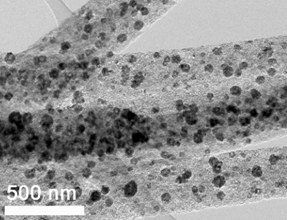
Fig. 1 Metal oxide-graphite composite and porous nanofibers with highly controllable diameter, particle size and performance.
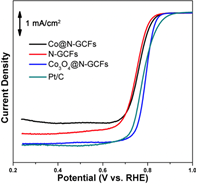
Fig. 2 Linear sweep voltametry curves shows that the graphitic nanofibers doped with metal ions have higher current densities than commercial platinum on carbon (Pt/C).
- *Principal Investigator
-
Name: David Kisailus
Department:
Name: Hongjie Tang
Department:
- Country/Region
- USA