
Potent And Highly Soluble Pegylated Compstatin Peptide
- Technology Benefits
- Inhibit complement activation by targeting protein C3, the converging point of all three complement activation pathwaysPossess highly improved aqueous solubility properties and overcome the aggregation limitation for clinical translation of previously known compstatin peptidesPossess significantly improved inhibitory efficacy and retain inhibitory potency, compared to previously known compstatin peptides
- Detailed Technology Description
- None
- Application No.
- 20180057538
- Others
-
Background
Lack of regulation in complement response is implicated in the pathology of several disorders, such as age-related macular degeneration, paroxysmal nocturnal hemoglobinurea, rare kidney diseases, chronic obstructive pulmonary disease, lupus, rheumatoid arthritis, asthma, adult respiratory distress syndrome, hemolytic anemia, rejection of xenotransplantation, stroke, heart attack, and ischemia reperfusion injuries. Regulating complement activation is important to control inflammation, autoimmune diseases, and infections. The compstatin family of peptides have been shown to be potent inhibitors of complement system activation and are promising candidates to become therapeutics for the treatment of age-related macular degeneration, and other complement-mediated diseases.
Applications
- Therapeutics for age-related macular degeneration (both dry and wet forms)
- Potential therapeutics for other complement system-mediated inflammatory and autoimmune diseases, such as paroxysmal nocturnal hemoglobinuria, atypical hemolytic uremic syndrome, C3 glomerulopathy, chronic obstructive pulmonary disease, lupus, rheumatoid arthritis, and ischemia reperfusion injuries
Patent Status
Patent Pending
Related Materials
Tech ID/UC Case
27122/2017-046-0
Related Cases
2017-046-0
- *Abstract
-
UCR researchers have developed novel compstatin peptides with polar amino acid extensions at the N-terminus and PEGylated extensions at the C-terminus. The new peptides have the following advantages compared to previously known compstatin peptides: (i) highly improved aqueous solubility while maintaining high inhibitory potency, and (ii) higher inhibitory efficacy against complement system activation in a human retinal pigmented epithelial cell-based assay that mimics the pathobiology of age-related macular degeneration. The combined solubility and inhibitory potency and efficacy properties render the new peptides excellent candidates to become therapeutics for the treatment of age-related macular degeneration.
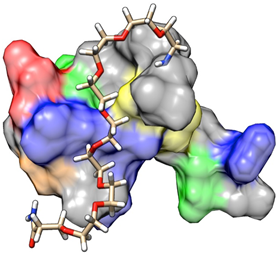
A potent and highly soluble compstatin peptide shown in surface representation with an 8 PEG block C-terminal extension displayed in stick form. The surface of the compstatin analog is colored according to amino acid properties: gray for hydrophobic, green for polar neutral, blue for polar positively charged, red for polar negatively charged, yellow for cysteines of the disulfide bridge, and brown for glycine. The molecular image is generated using three-dimensional coordinates from a molecular dynamics simulation trajectory.
- *IP Issue Date
- Mar 1, 2018
- *Principal Investigator
-
Name: Andrea Cabrera
Department:
Name: Kaustabh Ghosh
Department:
Name: Ronald Gorham, Jr.
Department:
Name: Reed Harrison
Department:
Name: Rohith Mohan
Department:
Name: Dimitrios Morikis
Department:
- Country/Region
- USA