
Hydrogel Scaffold for 3D Tissue Culture
- 技術應用
- Scaffold may be used for tissue engineering applications with a single-step cell seeding process and gelation in vivo Scaffold may be used in vitro tissue models for drug discovery
- 詳細技術說明
- None
- *Abstract
-
Prof. Jin Nam and his colleagues at the University of California, Riverside have developed a hybrid scaffold which combines a thermosensitive hydrogel, poly(ethylene glycol)-poly(N-isopropylacrylamide) (PEG-PNIPAAm), with a biodegradable polymer, poly(ε-caprolactone) (PCL), into a composite, electrospun microfibrous structure. The electrospun structure enables a structurally self-supporting hybrid scaffold which requires a simple inoculation of cell-containing media to encapsulate cells in a 3D hydrogel within a network of PEG-PNIPAAm/PCL microfibers.
This novel hybrid scaffold enhanced chondrogenic differentiation of human mesenchymal stem cells (hMSCs), resulting in superior mechanical properties of the cell/scaffold constructs as compared to those of the pure forms of its constitutive components. The hybrid scaffold enables a single-step uniform cell seeding process to inoculate cells within a 3D hydrogel with the potential for various tissue engineering applications.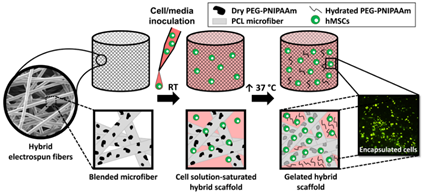
Figure 1. Schematic of electrospun hybrid scaffolds for moldless 3D cell encapsulation in hydrogel. Thermosensitive PEG-PNIPAAm composited with PCL was electrospun to produce thick (~ 2.5 mm) hybrid scaffolds composed of micro-sized fibers. Large pores allow uniform cell infiltration upon seeding throughout the thickness of the scaffolds at room temperature. Subsequent increase in temperature to 37 °C induces the PEG-PNIPAAm to gelate to encapsulate the uniformly seeded cells in 3D.
- *Principal Investigation
-
Name: Alexander Brunelle
Department:
Name: Jin Nam
Department:
- 其他
-
Background
Hydrogels have shown great potential for various tissue engineering applications due to their capability to encapsulate cells within biomimetic, 3-dimensional (3D) microenvironments. However, the multi-step synthesis processes to generate cell/scaffold constructs with defined dimensions, limits their off-the-shelf translational usage.
Tech ID/UC Case
29018/2017-679-0
Related Cases
2017-679-0
- 國家/地區
- 美國